
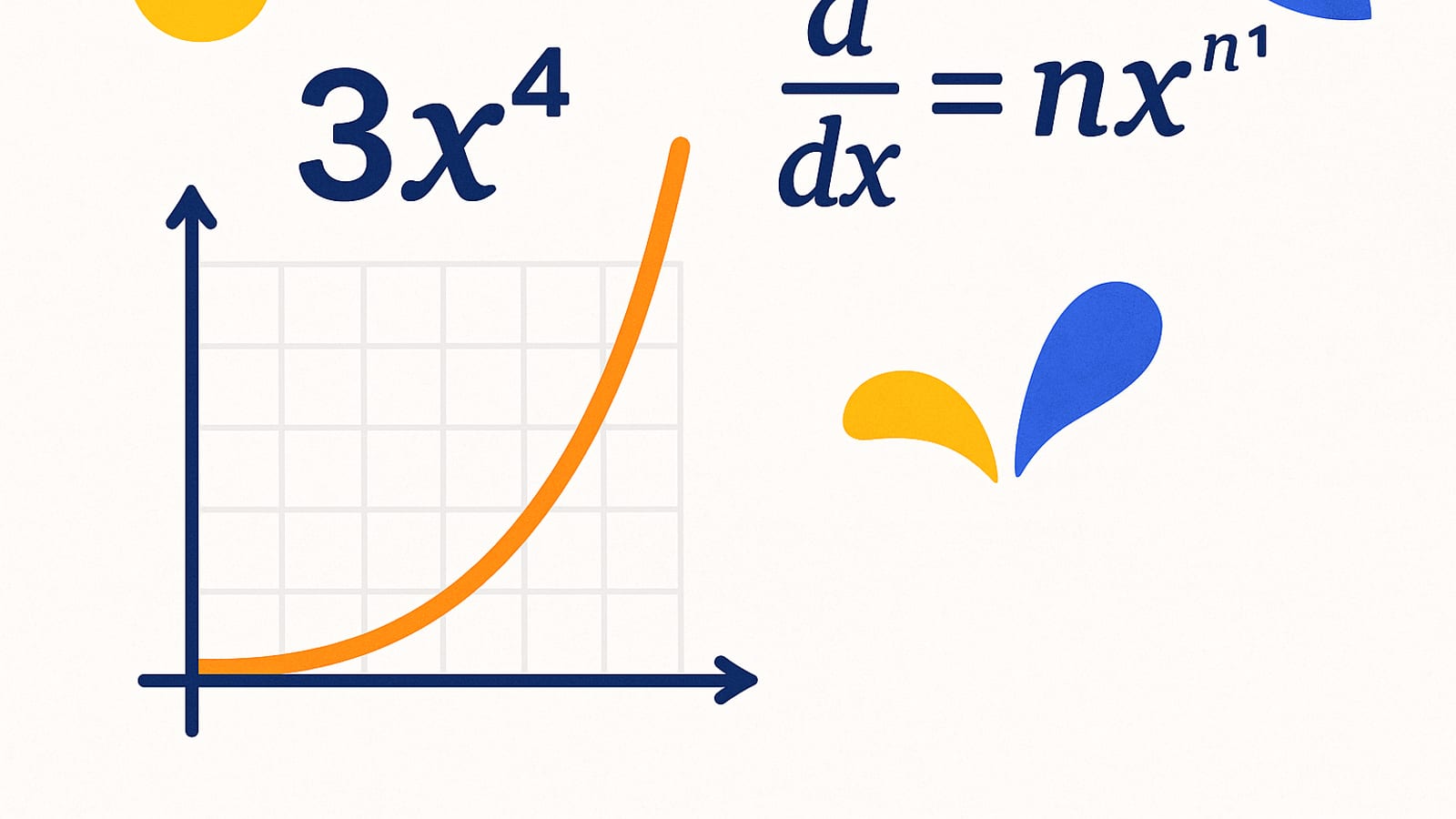
Understanding the Power Rule in Calculus
Let’s break down the Power Rule. It’s one of the most useful tools you’ll pick up in calculus, and once you see how it works, you’ll be able to differentiate polynomial functions quickly and with confidence. Walk through this guide step by step, and by the end you’ll know not just how to use the rule, but why it works.
What is the Power Rule?
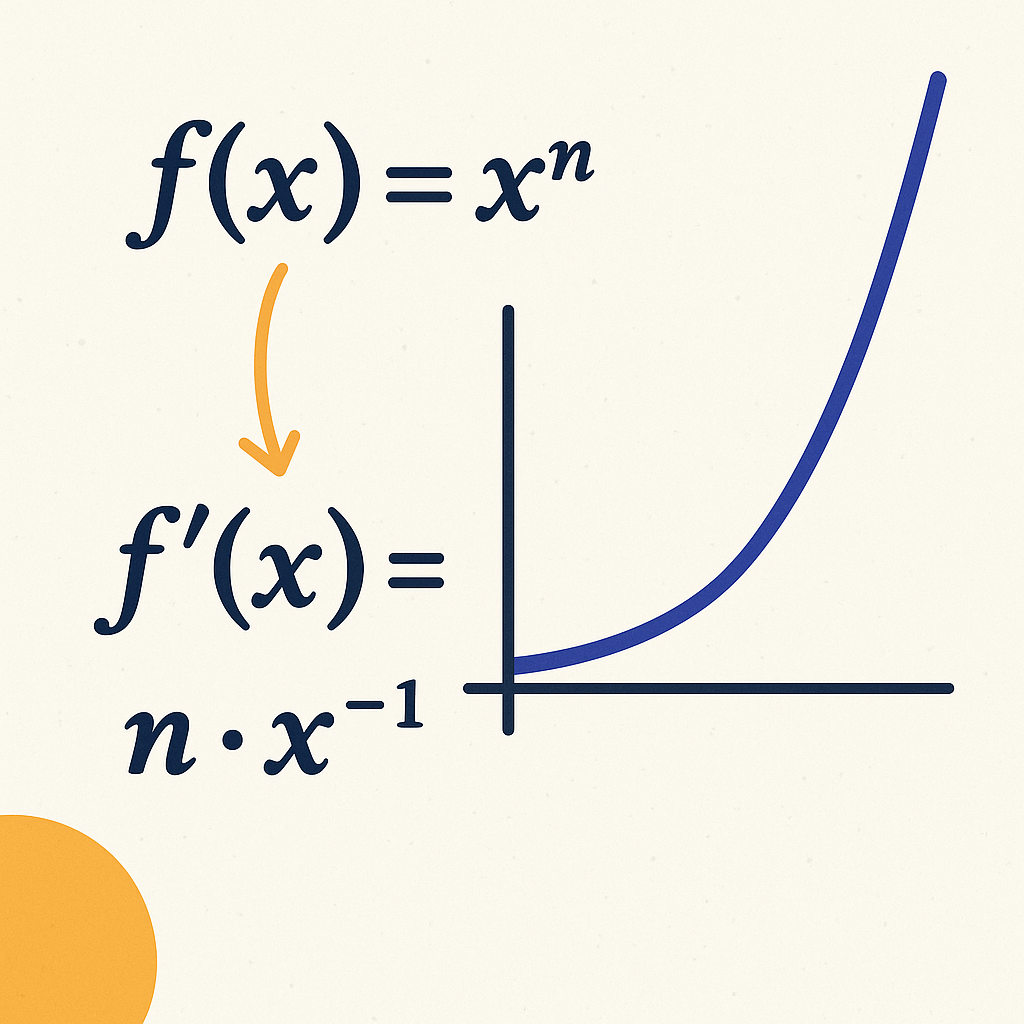
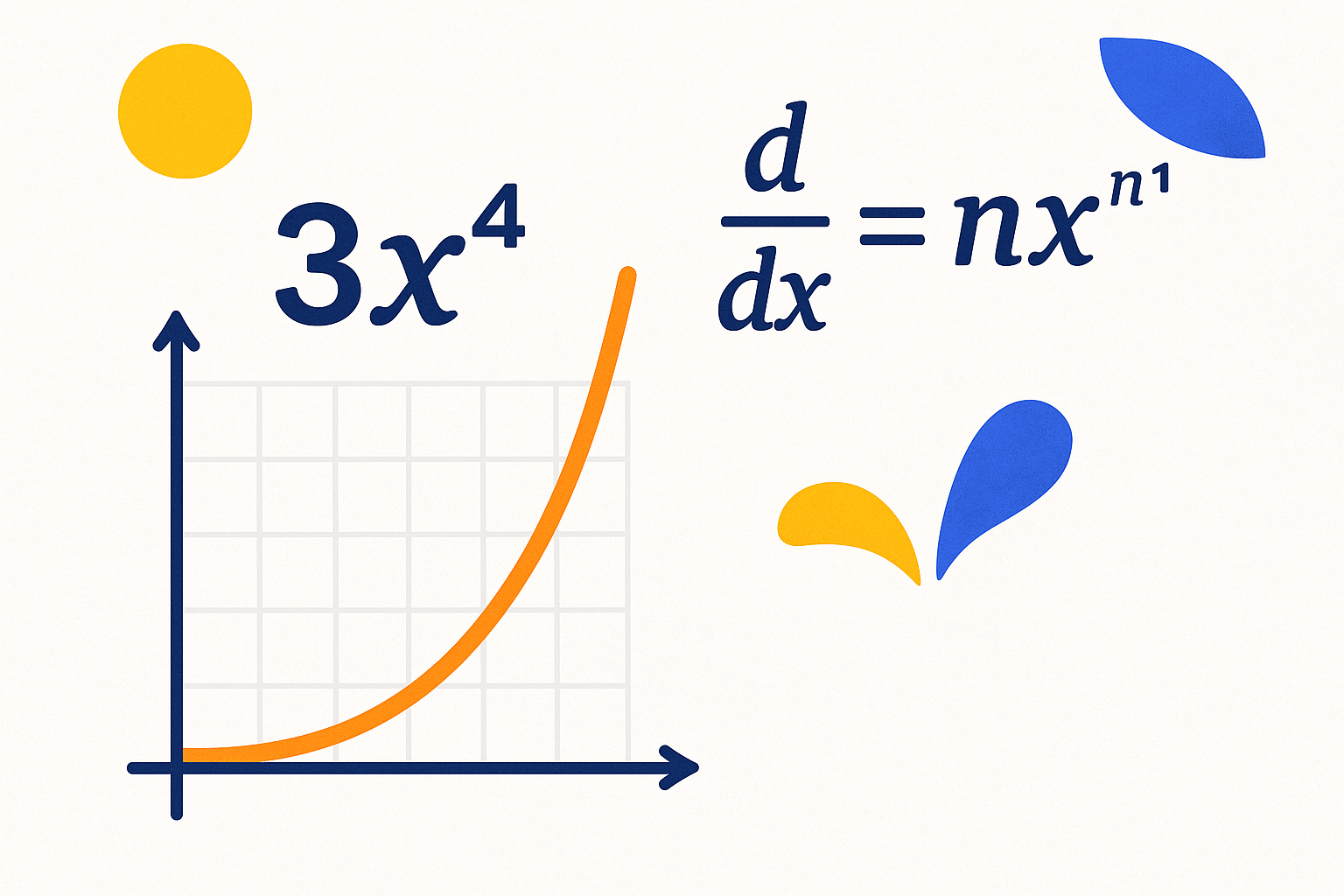
The Power Rule is a shortcut for finding the derivative of any function in the form f(x) = xn. In other words, if your function looks like x raised to some power, this rule tells you the derivative is n xn-1. You bring the exponent down front, then drop the exponent by one. That’s the whole idea.
Step-by-Step Guide to Using the Power Rule
Let’s break it down into four clear steps:
- Identify the exponent: Look at the term you want to differentiate and note the exponent on x.
- Bring the exponent down: Multiply the term by that exponent. This moves the exponent out front as a coefficient.
- Subtract one from the exponent: Reduce the original exponent by one. That becomes the new power of x.
- Combine: Write the new term using the results from steps 2 and 3.
Here’s why it works: each term in a polynomial gets differentiated on its own, and the Power Rule gives you a fast, reliable way to find the slope of that term at any point. You’re not guessing — you’re following a pattern that holds every time.
Examples of the Power Rule
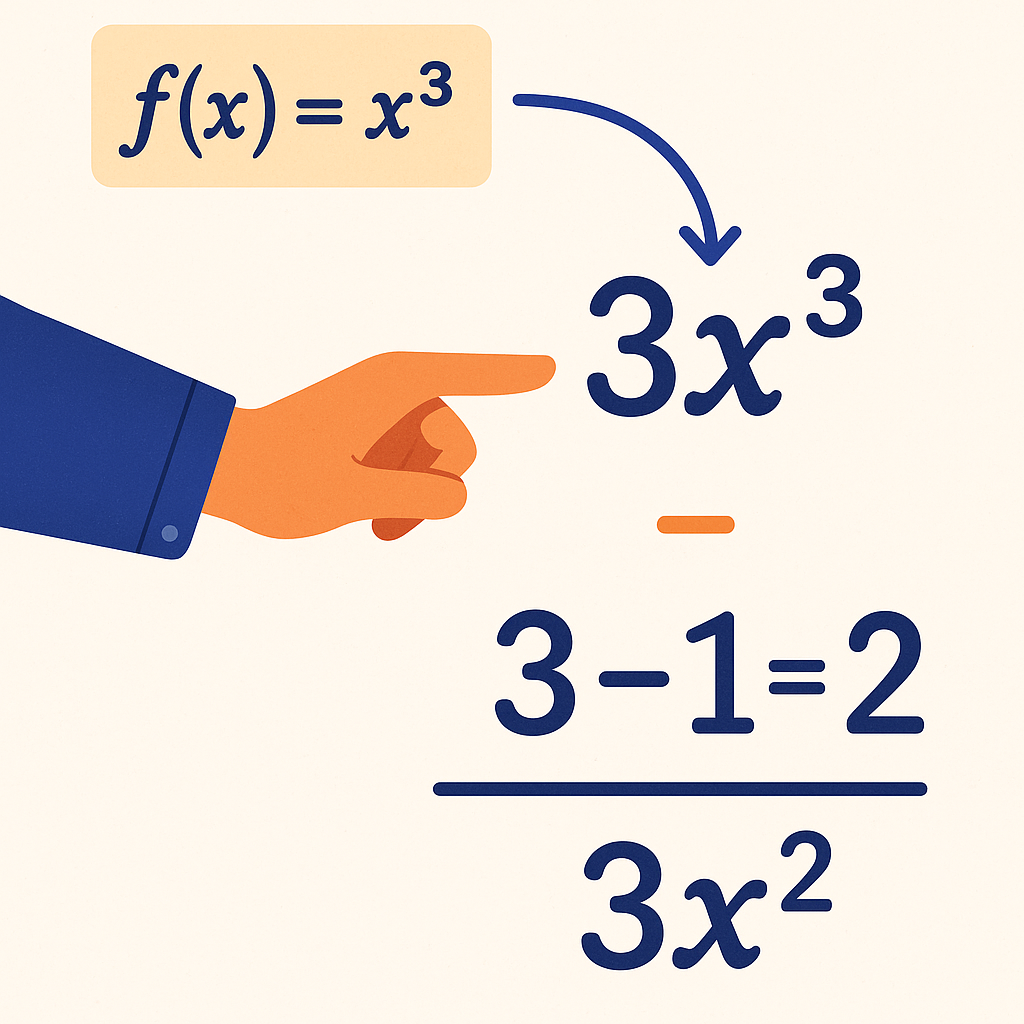
Let’s apply those steps to a couple of real examples so you can see the pattern in action.
Example 1: f(x) = x3
- Identify the exponent: The exponent is 3.
- Bring the exponent down: Multiply by 3, giving you 3x3.
- Subtract one from the exponent: 3 – 1 = 2.
- Combine: The derivative is 3x2.
In other words, differentiating x3 gives you 3x2. Notice that the exponent became the new coefficient, and the power dropped by exactly one.
Example 2: f(x) = 5x4
- Identify the exponent: The exponent is 4.
- Bring the exponent down: Multiply by 4: 5 4x4.
- Subtract one from the exponent: 4 – 1 = 3.
- Combine: The derivative is 20x3.
Notice that the existing coefficient 5 multiplies with the brought-down exponent 4, giving you 20. That’s why the derivative is 20x3 and not just 4x3.
Why the Power Rule Makes Calculus Easier
The Power Rule cuts out a lot of the heavy lifting when you’re working with polynomials. Instead of grinding through long calculations, you can find the slope of a curve at any point in just a few seconds.
In other words, getting comfortable with the Power Rule sets you up to tackle bigger problems with confidence. It’s a stepping stone toward other derivative rules, like the Product Rule and the Quotient Rule, which build directly on the same thinking.
Next Steps: Practice and Application
Now that you’ve seen how the Power Rule works, try it on a few polynomial functions on your own. Start with something straightforward, then push yourself toward more complex expressions. Each problem you work through makes the next one feel more familiar.
When you’re ready to go further, check out our guides on the Sum and Difference Rule and other derivative techniques. These will help you build a solid foundation in calculus and prepare you for more advanced topics.
Every time you apply the Power Rule, you’re reinforcing the pattern. Keep at it, and before long it will feel automatic.
For more step-by-step explanations and examples, visit our website. You’ll find a full library of math and physics lessons, each one designed to be completed in a single sitting so you can make real progress without feeling overwhelmed.
Bookmark this page and come back whenever you need a refresher. You’ve got this.
Common Mistakes and How to Avoid Them
A few errors come up again and again when people first use the Power Rule. Here’s what to watch for:
- Forgetting to Adjust the Exponent: After multiplying by the original exponent, you must subtract one from it. Double-check that step every time — it’s the one most people skip.
- Ignoring Coefficients: If the term already has a coefficient, multiply it by the exponent you brought down. Skipping this gives you the wrong answer.
- Not Simplifying the Result: After applying the rule, simplify your expression. A clean result is easier to read and easier to use in the next step of a problem.
- Applying the Rule to the Wrong Functions: The Power Rule works for terms of the form xn. Notice that exponential and logarithmic functions follow different rules entirely, so don’t force this one where it doesn’t belong.
Keep these points in mind as you practice, and you’ll avoid the most common traps. The Power Rule is reliable — as long as you follow each step carefully, your results will be accurate.



Leave a Reply